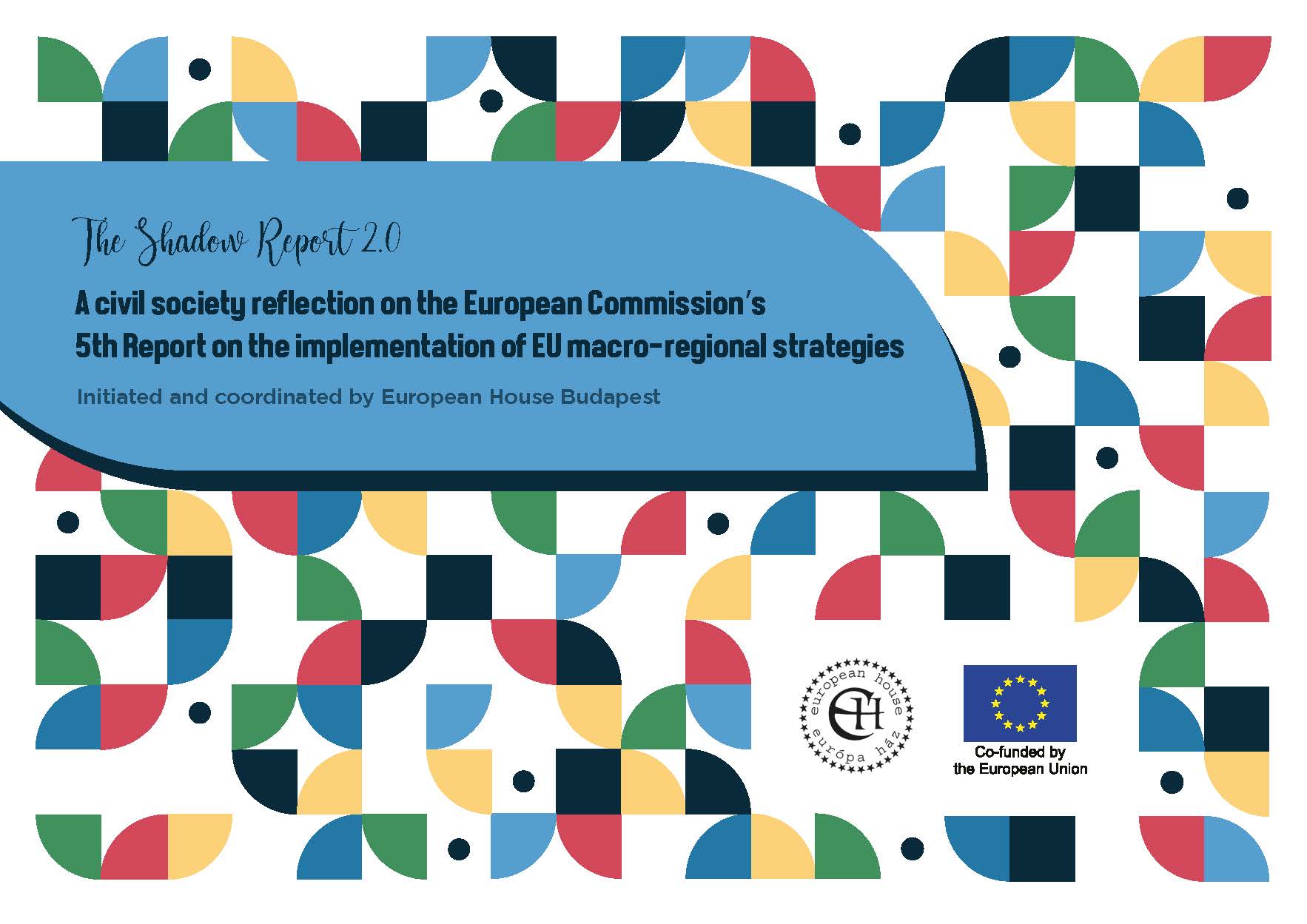
Civil society organisations active in the EU macro-regions are urging the EU, the Member States and other stakeholders to give them a stronger and more structured role in shaping and implementing macro-regional strategies (MRS). This call is captured in the newly released Shadow Report 2.0, a reflection and response to the European Commission’s 5th Report on the implementation of the EU’s macro-regional strategies.
Initiated and coordinated by European House Budapest, the Shadow Report 2.0 brings together the voices of civil society organisations, members of Connect, the macro-regional civil society network. Unlike traditional reports, this second edition is deliberately more colourful, diverse, and direct – reflecting the nature of civil society itself.
Ten proposals for change
At the heart of the report are ten proposals aimed at ensuring that macro-regional strategies deliver tangible benefits to citizens and their organisations. Among the key recommendations are:
- Partnership in practice: Civil society should have a regulated presence in MRS governance structures, with the possibility to lead thematic areas.
- Civil Society Strategy: A dedicated strategy for civil society involvement is needed, ensuring policies are not only top-down but also inclusive and responsive.
- Cross-border cooperation: Member States should remove legal and administrative barriers, while adopting the European Cross-Border Association (ECBA) directive to make collaboration more effective.
- Youth engagement: A Macro-Regional Youth Summit and a peer-to-peer exchange programme would nurture leadership, intercultural understanding, and solidarity across borders.
- Funding security: Moving from ad hoc to sustainable funding would allow CSOs to build long-term capacity and meaningfully contribute to governance.
Other proposals focus on piloting innovative cohesion solutions, celebrating shared identities through “The Best of macro-regions” initiative, and recognising the vital role of CSOs in preparing candidate countries for EU membership.
An uneven landscape
The report highlights the uneven treatment of civil society across Europe’s macro-regions. In some countries, CSOs are trusted partners in policy-making; in others, they are sidelined, mistrusted, or even restricted. This inconsistency is particularly challenging in strategies that include both EU and non-EU countries.
Yet, the document underlines, civil society is uniquely equipped to address today’s pressing transnational challenges – from climate change to disinformation – through flexible networks, knowledge sharing, and local embeddedness.
The Shadow Report 2.0 ultimately makes the case that genuine partnership between the EU, governments and civil society is not just desirable but essential. Without it, the EU’s macro-regional strategies risk remaining abstract frameworks rather than living policies that citizens can relate to.
“Civil society should be treated not as an obstacle but as an indispensable partner in building a stronger, more democratic, and more resilient Europe,” the report concludes.
The Shadow Report 2.0 is presented at the Macro-regional & Sea Basin Strategies Days 2025 organised in Brussels on 24-25 September 2025 and the 17th High level group meeting on the Macro-Regional Strategies on 26 September 2025.
Shadow Report 2.0 – print friendly version
