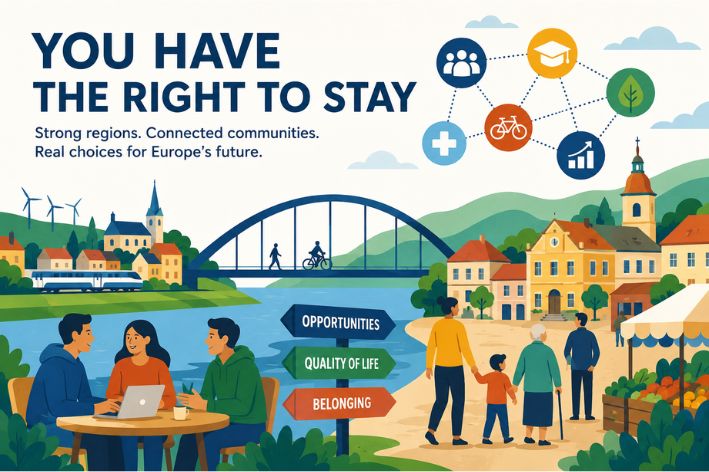
CONNECT, the macro-regional civil society network, has submitted a Position Paper to the European Commission’s public consultation on the forthcoming Right to Stay Strategy. In our opinion, we welcome the Commission’s initiative to address territorial disparities and demographic challenges across Europe, while highlighting the importance of macro-regional cooperation, cross-border governance, civil society participation and place-based development.
You have the right to stay
Across Europe, millions of people are on the move. Young people leave rural communities in search of education and employment. Families relocate because services are disappearing from their hometowns. Entire regions struggle with demographic decline, labour shortages and shrinking opportunities.
Freedom of movement is one of the European Union’s greatest achievements. But there is another freedom that deserves equal attention: the freedom to stay.
People should not be forced to leave their communities because of a lack of jobs, poor transport connections, inadequate healthcare or limited educational opportunities. Every European citizen should have a genuine choice: the opportunity to build a good life where they live, if they wish to do so.
This is the idea behind the European Commission’s emerging Right to Stay Strategy. It recognises a growing reality across many parts of Europe: territorial inequalities are undermining social cohesion, economic resilience and citizens’ trust in democratic institutions. The challenge is particularly visible in border regions, rural areas and peripheral territories, where population decline and outmigration often create a vicious cycle of reduced services, weaker economies and diminished prospects.
For CONNECT, the macro-regional civil society network, the right to stay is not simply a demographic issue. It is a question of territorial justice, democratic participation and the future cohesion of the European project.
Stronger regions through cooperation
Europe already possesses valuable tools for addressing these challenges. The EU’s macro-regional strategies – covering the Danube, Baltic Sea, Adriatic-Ionian and Alpine regions – demonstrate how cooperation across borders can help territories tackle shared economic, social and demographic pressures.
These frameworks bring together cities, towns and rural communities facing similar challenges. They facilitate knowledge-sharing, joint planning and coordinated action, helping regions become more resilient and competitive while preserving their unique identities.
The future Right to Stay Strategy should build on these experiences and recognise macro-regional cooperation as a key instrument for implementation.
Border regions must not be left behind
For many Europeans, daily life already extends across borders. People work, study, access healthcare and use public services in neighbouring countries. Yet legal and administrative obstacles continue to make cross-border cooperation unnecessarily difficult.
This is why CONNECT supports renewed efforts to establish a European Cross-Border Association (ECBA), a practical instrument that could help local and regional authorities manage shared services, implement joint development strategies and strengthen functional cross-border regions.
Removing barriers to cooperation is not merely a technical exercise. It directly improves quality of life and expands opportunities for citizens. In many border regions, it could become a powerful tool for making staying a realistic and attractive option.
Communities matter as much as infrastructure
Investing in roads, railways and digital connectivity is important, but infrastructure alone will not persuade people to remain in a region.
People stay where they feel connected, represented and valued. Strong communities, vibrant cultural life, active civil society organisations and opportunities for participation all contribute to a sense of belonging.
Local associations, youth organisations, cultural initiatives and community groups play a vital role in strengthening social cohesion and democratic resilience. They help build trust, encourage innovation and foster the local identities that make places attractive to live in.
The right to stay therefore requires more than investment. It requires participation.
Giving young people reasons to return
Too often, public debate frames youth mobility as a problem to be solved. In reality, mobility is often beneficial for both individuals and regions. The challenge is not that young people leave; it is that many never return.
Europe should move beyond discussions of „brain drain” and instead promote what might be called „brain circulation”. Temporary mobility, international experience, cross-border careers and remote working can all contribute to regional development when strong links with home regions are maintained.
Young people are far more likely to remain in, or return to, places that offer quality education, affordable housing, cultural opportunities, sustainable mobility and meaningful employment. Supporting regional talent networks, return programmes, cross-border traineeships and remote working hubs could help transform mobility into an asset rather than a loss.
A place-based approach for Europe’s future
No two regions face exactly the same challenges. Solutions that work in metropolitan areas may not be suitable for remote rural communities or border territories.
That is why the Right to Stay Strategy must embrace a genuinely place-based approach. Policies should be tailored to local realities and supported by strong local governance, long-term investment and better coordination between European funding instruments.
Particular attention should be paid to regions experiencing demographic decline, transport poverty and unequal access to essential services. Territorial diversity is one of Europe’s strengths; policy should reflect that reality.
The next EU budget must match the ambition
A successful Right to Stay Strategy cannot rely on good intentions alone. It requires adequate resources.
As discussions begin on the next Multiannual Financial Framework for 2028–2034, territorial cohesion and demographic resilience should become strategic priorities across EU funding programmes. Cohesion Policy must remain strong and sufficiently funded, while greater synergies should be created between regional development, education, innovation, employment and social policies.
Without sustained investment, the right to stay risks remaining an aspiration rather than becoming a reality.
A democratic imperative
The debate about territorial cohesion is often presented in economic terms. But it is also profoundly democratic.
Regions experiencing long-term decline frequently see rising frustration, declining trust and growing political disengagement. The geography of economic inequality can easily become a geography of democratic discontent.
Strengthening opportunities in all regions helps strengthen confidence in democratic institutions and reinforces the resilience of European societies. Ensuring that citizens can choose to remain and prosper where they live is therefore not only a cohesion objective; it is part of Europe’s democratic resilience agenda.
The right to choose
Ultimately, the right to stay is about choice.
Europe should continue to celebrate mobility, openness and opportunity. But citizens should never feel compelled to leave their communities simply because development has bypassed their region.
The future Right to Stay Strategy offers an opportunity to rebalance this equation. By investing in people, communities and territories, Europe can ensure that staying becomes a genuine option alongside moving.
Every citizen should be free to explore opportunities elsewhere. But they should also have the right to build a future at home.
That is what the right to stay means.
Opinion of Connect, the macro-regional CSO Network on the Commission’s Right to Stay Strategy
