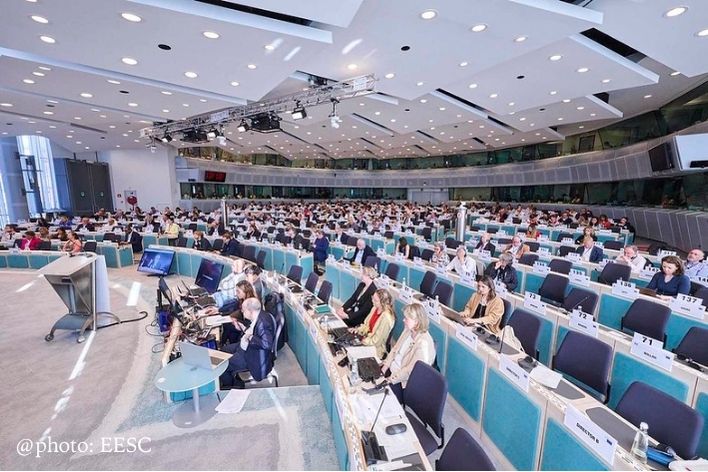
On 29 April, the European Economic and Social Committee (EESC) held a plenary debate on the future of EU cohesion policy with Commission Vice-President Raffaele Fitto. EESC President Oliver Röpke opened the session by highlighting the importance of discussing not only the mid-term evaluation but also the long-term direction of Cohesion Policy. He reiterated the Committee’s strong support for cohesion as the EU’s primary investment tool, rooted in place- and people-based principles and the partnership model. He also called for the policy to address pressing challenges beyond defense, including housing and competition policy.
Vice-President Fitto emphasised the vital role of the EESC in ensuring EU policies reflect civil society’s perspectives and needs. He welcomed the Committee’s opinion on the cohesion policy mid-term review, acknowledging that today’s socio-economic and geopolitical conditions differ significantly from when the current programming rules were designed.
Fitto noted that regions and cities continue to grapple with issues such as access to housing and water resilience, while new priorities – like competitiveness, defense, and security – have emerged. The Commission’s mid-term review is intended as a shared response to these shifting realities.
Looking ahead, Fitto stressed that the aim is not to alter the core mission of cohesion policy, but to adapt and strengthen it for the future. To this end, the Commission is proposing greater flexibility and direct funding under five new strategic priorities: (1) competitiveness, (2) defense and security, (3) affordable housing, (4) water resilience, and (5) energy transition. He described the proposal package as an important milestone, while underscoring that continued commitment, pragmatism, and cooperation are essential to modernising the Cohesion Policy.
In the ensuing discussion, EESC members raised a range of key issues including the need for stronger social dialogue as a funding condition, enhanced inclusion of low-skilled and vulnerable groups, expanded lifelong learning with local stakeholder involvement, education and digital transformation, climate adaptation, unemployment, and energy independence.
The debate is available here.
